


 Twisted pair cables
 Coaxial cables
 Fibre optic cables Twisted pair cables
The most commonly used communications cables.
Twisted pair cables
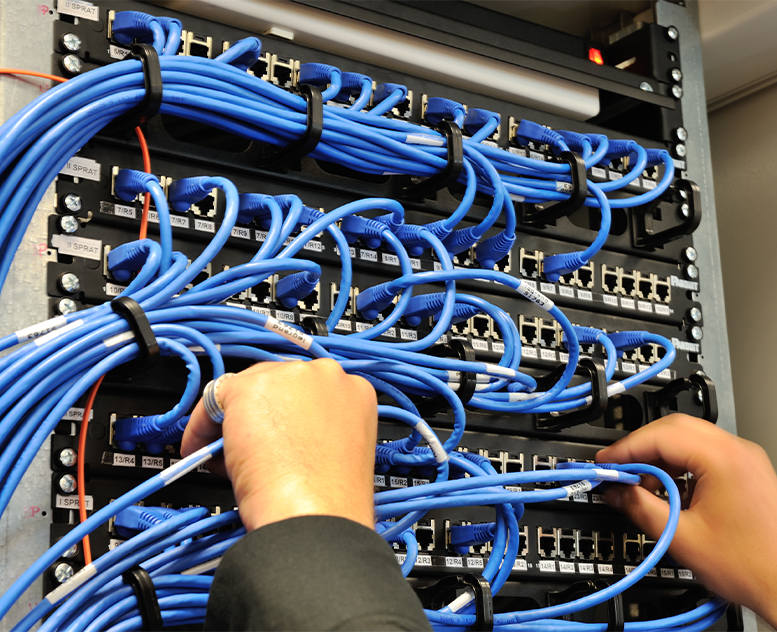
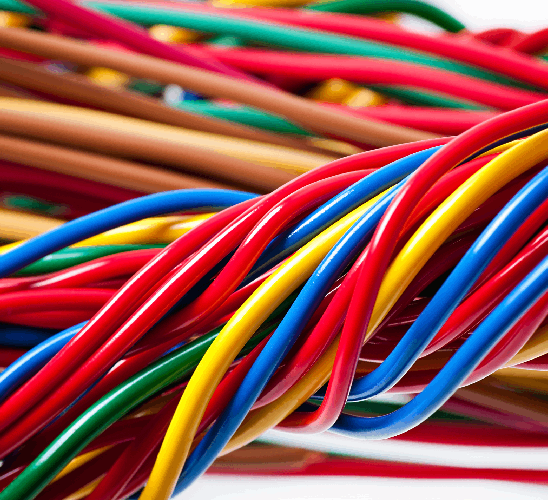
Twisted pair cables are used for telephone communications in local area networks like offices, retail stores, and commercial sites.
Twisted pair cables consist of four thin wire pairs wrapped in insulation. Each cable pair is twisted to prevent potential interference from other devices and other adjacent cables. When two wires in an electrical circuit are close, their magnetic fields cancel each other and any outside magnetic fields out. Cable twisting further enhances the cancellation effect, ensuring self-shielding within the network media.
There are two types of twisted-pair cables: unshielded twisted pair (UTP) and shielded twisted pair (STP) cables.
Unshielded twisted pair (UTP) cables
UTP cable harnesses the twisted wire cancellation effect to curb signal degradation caused by electromagnetic interference (EMI) and radio frequency interference (RFI). The number of twists in each of the wire pairs varies to further reduce unwanted signal transfers. UTP cables are often installed with Registered Jack 45 (RJ-45) connectors. This type of network cables are designed to follow precise specifications regarding how many twists are permitted per meter length.
Category 1 UTP cable
This type of cable is primarily used for telephone communications and isn’t suitable for data transmission.
Category 2 UTP cable
Category 2 UTP is used for transmitting data and is capable of transfers at speeds of up to 4 megabits per second.
Category 3 UTP cable
This cable type is used in 10BASE-T networks and can transmit data at speeds up to 10 megabits per second.
Category 4 UTP cable
Category 4 UTP is used in Token Ring networks, with the ability to transmit data at speeds up to 16 megabits per second.
Category 5 UTP cable
Category 5 transmits data at speeds of up to 100Mbps, while the 5e variant transfer speed goes up to 1 GBps.
Category 6 UTP cable
Category 6 is currently the fastest UTP standard, typically consisting of four pairs of 24 AWG copper wires.
Category 7 UTP cable
Category 7 is ideal for larger businesses, ensuring protection from external interference and a bandwidth of 600 MHz.Shielded twisted pair (STP) cables
Shielded twisted-pair (STP) cable combines the shielding, cancellation, and wire twisting techniques to reduce electrical noise within and from outside the cable. This twisted cable ensures a speed and throughput of 10 to 100 megabits per second. Each wire pair in an STP cable is insulated in a metallic foil, and every four pairs of wires are additionally wrapped in a metallic braid. STP is better at preventing interference than UTP, so its installation process is more expensive and demanding. Coaxial cables
Used in areas that require high bandwidths.
Coaxial cables
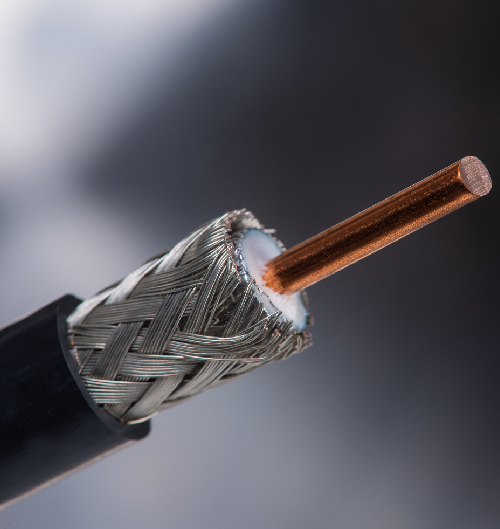
Coaxial cable is made of a single inner wire consisting of two conducting elements and a hollow outer cylindrical conductor. Around the flexible insulation is a metallic foil that acts as the second circuit wire and a shield for the inner conductor.
The coaxial cable supports data transfer speeds of 10 to 100 Mbps and can cover longer distances than twisted pair cabling.
50 Ohm Coax cable
These coaxial cables are mainly used to transmit data in two-way communication systems like ethernet, radio receivers, GPS, police scanners and smartphone systems.
75 Ohm Coax cable
This type of coaxial cable is typically implemented in audio and video systems, for purposes such as transmitting video signals among components like DVD players. Fibre optic cablesprimarily used to connect satellite antenna facilities to homes and businesses.
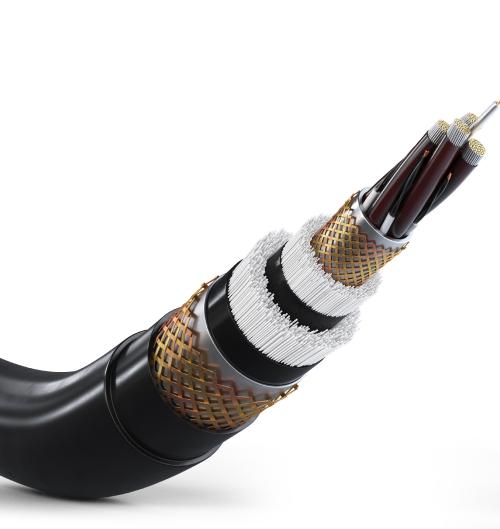
Fibre optic cables
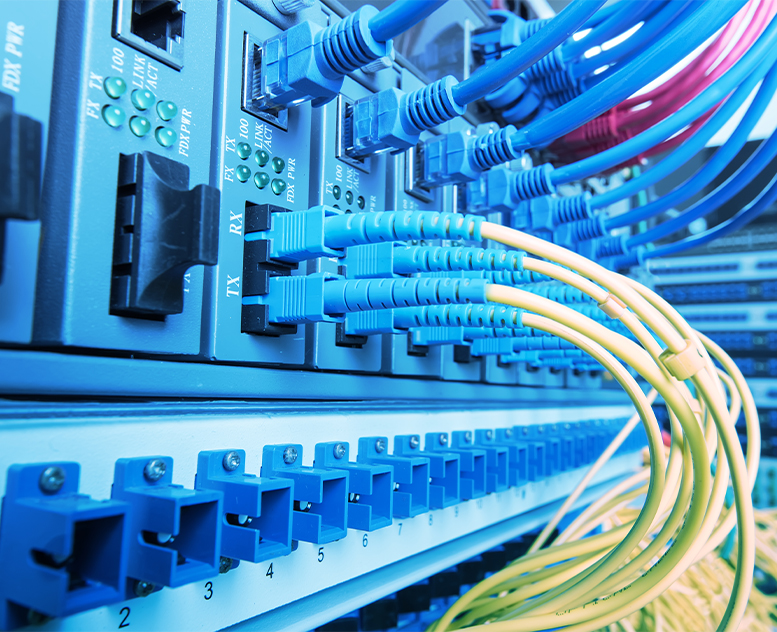
Fiber optics are cables made of glass fibers, able to transmit light signals over long distances. This type of cabling enables ultra-fast connections: more than 26,000 times the transmission capacity compared to twisted pair cables.
Fibre optics are ideally suited for industrial communications and telecommunications networks. They are also used to transmit high-power laser energy, which creates opportunities for advanced medical and military applications.
Single-mode fibre optic cable
This type of fibre optic cable is frequently used in the telecommunications industry. Single-mode fibres have a small diameter, typically 9 µm. The number of light reflections decreases as the signal passes through the core, allowing data to move further and faster.


