Beginner’s Guide to Security Cameras for Business
surveillance cameras for businesses are one of the most secure way to protect your premise, assets, and employees. Thanks to technological advancements, installing a security system is more efficient and cost-effective than ever.
However, choosing the right surveillance cameras can be an overwhelming experience. With so many options available on the market, it is often challenging to make the right choice.
In this beginner-friendly guide, learn about the best security cameras' specs, features, and purposes. We help you choose the best options to keep your business secure and thriving.
Benefits of remote video monitoring with surveillance cameras for businesses
The advantages of installing a surveillance system are manyfold. Investing in security cameras for business increases the safety of your premises, prevents break-ins and theft, safeguards your business against liabilities, and helps improve productivity in the workplace.
One of the most convenient features of surveillance cameras is remote video monitoring. Remote monitoring is a system that allows you to inspect a live data feed from a surveillance device from a remote location anywhere in the world without the need to seek and employ professional security guards.
A remote video surveillance system is a perfect solution to your security concerns if you often travel, keep valuable assets at your place of business, and frequently have professionals such as cleaning personnel on their premises.
Elements of an effective surveillance system
To install a professional surveillance system capable of protecting your assets and personnel, you need to acquire and install an appropriate number of security cameras, a DVR or an equivalent device, and a monitor.
Setting up surveillance cameras for businesses
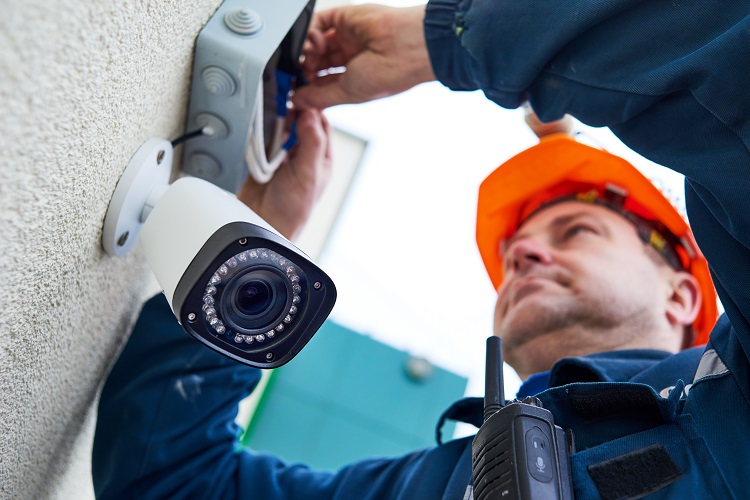
The first thing you must do when implementing your security system is to choose the locations of your cameras. Installation technicians come to your property to ensure the cameras are placed appropriately, answer your questions, and make a placement plan based on your security needs.
The second aspect is whether you want a wired or wireless security system. Wireless cameras are the more effective and versatile option for identification, unlike wired systems that have limitations on expanding the number of security cameras in the future.
Choosing the best DVR device
The recording element of the security system is the DVR (digital video recorder), a device that stores all video material on its internal hard drive. The industry standard for video compression is the H.264 model, capable of storing video three times longer than its MPEG and MPEG4 compression predecessors. It also enables better video quality over a live feed and Internet streaming.
PC systems vs stand-alone security DVRs
Although there are internal hardware upgrades you can buy to turn your computer into a security DVR, this process isn’t recommended. Given the complexity of the process and cost-effective pricing of stand-alone DVRs, any potential benefits such as a PC upgrade are far outweighed by the guaranteed quality of a professional solution.
Types of surveillance cameras for businesses
Surveillance cameras differ in the technologies used to create them and the video output quality. The most popular types of surveillance cameras include IP, HD and analog surveillance cameras.
IP surveillance cameras
IP surveillance cameras are also known as network cameras and can transmit images via the Internet. They usually do this by compressing bandwidth to reduce strain on the Web.
IP cameras can use hubs, switches, and routers to have an expanded range. With IP-based cameras, the network is safe from interference.
IP surveillance cameras are much easier to install than analog ones, as they do not need a power boost or even a separate cable to transmit images.
Types of IP surveillance cameras for businesses
There are numerous types of IP cameras out there, including fixed, wireless, dome, indoor, outdoor, and PTZ IP cameras. IP cameras can be classified depending on unit construction and Internet connection method.
An integrated IP camera is combined with the image processing unit, with a single lens that supports only one channel. A video server IP camera consists of the image processing unit, the transfer unit, and the networking module, without the video capture unit, supporting 2 to 32 multi-video input channels.
Wired cameras are connected to the Internet using UTP data cables such as a CAT 5. In contrast, wireless cameras are connected via Wi-Fi, Bluetooth or other wireless connections.
HD Surveillance Cameras for Businesses
HD cameras are surveillance devices with high definition, preferred for various niche markets. These cameras let operators zoom in on images with clarity that cannot be obtained using other surveillance cameras. HD cameras provide more detail and broader coverage than traditional analog CCTV cameras.
Analog Surveillance Cameras
Analog cameras are the oldest surveillance cameras, cheaper when compared to their high-definition counterparts. They work with video capture cards and involve cables for power and video output.
Analog vs digital image resolution
Some security cameras for business still use the analog format, limiting them to 420 to 600 lines. In the digital world, images are measured in pixels, and the highest HD format is 1080 x 720 pixels.
If you’ve ever seen a flickering effect on your SD TV when a DVD was paused, this happened because of interlacing. In the more advanced digital world, a progressive scan is used instead of this process. This process differs from interlacing in that each frame is a complete image, not rendered in lines but pixels.
Just as the greater the number of lines in an analog image makes for superior resolution, so does a greater number of pixels on a digital monitor produce a clearer, more detailed picture.
Why choose HD surveillance cameras for businesses?
Non-HD surveillance systems often produce unclear video footage, making HD surveillance systems superior. With an HD system, the footage is much clearer, so even if the criminal is masked, it may still be possible to find visual evidence.
If the sight of a security system doesn’t deter the thief in the first place, the HD camera will capture footage of the perpetrator in the act, which can assist in their arrest and successful prosecution.
For greater security of your business and its sensitive data, it’s recommended to combine the power of an HD surveillance system with purposeful access control.
Where to use HD surveillance cameras in business?
Many supermarkets use high-definition surveillance cameras to monitor customers and employees. High-definition cameras are also used in large workplaces and examination halls.
Large Retail
HD surveillance cameras can easily detect faces and monitor a person’s exact movements, dramatically decreasing loss prevention wherever they are installed.
Large Workplaces
HD surveillance cameras in businesses can ensure employees refrain from stealing and stay productive throughout the day. The advanced capabilities of a high-definition security system allow for a more comprehensive and meticulous surveillance process.
Parking Lots
High-definition cameras can also track activities in large open spaces such as building exteriors and parking lots. An efficient function of an HD surveillance system is its ability to render a readable image of a license plate number from a considerable distance.
Examination Halls
Due to ground-breaking detail detection, HD cameras can make it much easier to oversee professors and students in examination halls. Even the subtlest of movements can be recorded, helping discover and identify students who have engaged in academic dishonesty.
Does a business need audio with surveillance cameras?
CCTV systems with audio recording provide more accurate information, which is why intelligence organizations and law enforcement agencies use this advanced security technology. However, surveillance cameras with audio capabilities are also used by property and business owners with a vested interest in what transpires on their premises and establishments.
Since the proprietor or owner can see and hear what employees or other individuals on their premises are discussing, it is one of the best tools for monitoring operations.
Security cameras for business with audio capabilities are used for their effectiveness, demonstrated by their ability to record a conversation within a 30-foot radius, provided there is minimal background noise.
A video clip combined with an audio recording can be a very effective exhibit in the prosecution process during a criminal case.
Limitations of wireless surveillance cameras for businesses
Wireless cameras can be placed virtually anywhere, as long as the receiver and transmitter are in an unobstructed line. However, these devices have several limitations, including obstruction interference, proneness to manipulation, power consumption requirements, and high installation costs.
Obstructions such as walls or trees can hamper the transmission of signals from the transmitter to the receiver. Potential hindrances include other wireless signals that can cause enough interference to disrupt signal transmission completely.
Surveillance cameras are subject to manipulation, although challenging and require advanced hacking skills. A high-quality DVR and receiver can technically intercept signals from a wireless camera. Once the signal is intercepted, it can also be manipulated.
Additionally, a tech-savvy expert could block the transmission of a signal from a wireless camera if the frequency is known.
Wireless security cameras require a constant supply of power to function continuously. Since most use batteries, the battery status must be monitored to ensure they remain active.
Lastly, the cost of purchasing a modern wireless surveillance system is almost triple that of a hardwired system.
What is surveillance DVR, and how does it work?
DVR is a digital video recorder with surveillance cameras to record footage and display it on a monitor as digital images. It is a new surveillance technique becoming increasingly popular on commercial premises.
A DVR security system is an essential measure for businesses because of its versatility and effectiveness. It can be used with either analog or HD cameras and does not require additional storage devices such as obsolete and bulky VHS tapes.
The DVR takes an analog signal and converts it to digital, but digital does not necessarily mean high-definition. A digital video recorder can produce an HD image, but only in conjunction with a high-definition camera on the other end, which is the optimal arrangement with this type of technology.
Why is it good to pair HD cameras with a DVR?
High definition means better resolution or a higher quality image. If analog cameras are used with a DVR–a widespread setup–even though a digital image is presented on the monitor, it will be limited to the resolution quality of the analog camera.
If used with HD cameras, the video and images a DVR records and displays are so detailed and clear that it becomes a potent tool for identifying facial features and other details. This makes it easier for trespassers, thieves, and other criminals to be apprehended by the authorities simply because the identification process has been made significantly more straightforward.
Likewise, an HD image recorded by a DVR surveillance system can be used to more significant effect in the prosecution of an apprehended felon.
Using a DVR surveillance system with HD cameras is preferential, but this arrangement tends to be more expensive than a setup with analog cameras.
How to protect your DVR device and footage?
In case of a break-in, if the DVR is found and destroyed, so is all the evidence it contains. Therefore, locating the device off-site would be ideal.
A recommended practice is installing a DVR recording video on one facility inside another and vice versa. That way, if the break-in happens and perpetrators find a DVR, they will destroy the wrong surveillance footage without knowing it.
To prevent property destruction, you should also consider installing a reliable alarm system to stop criminal activity in its tracks and receive notifications if the break-in ever happens.
When to upgrade your existing surveillance system?
The most reliable way to make the most of your surveillance system is to keep it up-to-date and regularly maintained. When your surveillance system has gone out of date and is comfortably outperformed by more modern devices, it’s high time for an upgrade.
For example, suppose your company or organization is still using VHS recorders today. In that case, you should seriously consider upgrading to the far superior DVR, as it is a much more flexible and powerful tool than a VHS recorder. Digital wireless systems are preferable to analog alternatives as they are far more secure and much more difficult to tamper or interfere with.
Another area that should be considered is making the transition from black and white cameras to color cameras with higher resolution. It goes without saying that the process of apprehending criminals and thieves is significantly easier with a high-quality camera.
What is the best type of surveillance system camera for business?
IP cameras are a great example of how much technology has progressed as they have built-in network functionality that enables security personnel to operate or access them remotely. This kind of flexibility could dramatically alter the way a security company deals with the task of reviewing security footage.
Furthermore, the IP camera also comes with all state-of-the-art features expected from such a high-end product, including LED night vision, weatherproof protection and PTZ control.
Differences between outdoor and indoor security cameras
There are a number of differences between outdoor and indoor security cameras. The aspects to look at include mounting location, environmental concerns, and product build.
While indoor cameras are designed to monitor insides of your premises, outdoor alternatives need to be mounted to effectively oversee the exterior of your working space.
The environmental factors also bring out major differences between indoor and outdoor cameras, affecting how they are made to withstand such conditions. An outdoor camera needs to work under different lighting conditions than an indoor security camera. At night, the outdoor camera needs to capture a more detailed video in a less illuminated condition. Therefore, it has to be more powerful than its indoor alternative.
Indoor and outdoor cameras also differ in build. Since outdoor cameras are exposed to potential adverse weather conditions, they have to be waterproof and sturdier than indoor models. The frame or body of an outdoor camera is made of metal, while the indoor option, which can afford to be weaker, is made out of plastic.
The difference in materials, expectedly, results in a price difference. Since metal is more expensive than plastic, outdoor cameras are more costly than indoor ones.
Lastly, outdoor cameras are often larger than the indoor ones.
Bullet cameras vs dome cameras: what are they for?
Dome cameras are originally intended for ceilings, while bullet cameras are designed for wall mounting. However, the initial intention of ceiling or wall attachment should not be the ultimate deciding factor, since mounting brackets can be purchased for either model to allow for alternate placement.
Bullet and dome cameras are somewhat similar in terms of functionality, but each has a different purpose.
Dome cameras are the better choice when it comes to discretion. They are hard to spot, usually blending in with their surroundings. They also have a smoke dome, which makes it nearly impossible to determine where the camera is directed.
Since dome cameras are vandal-proof, they are a better choice for areas with high incidents of crime and theft.
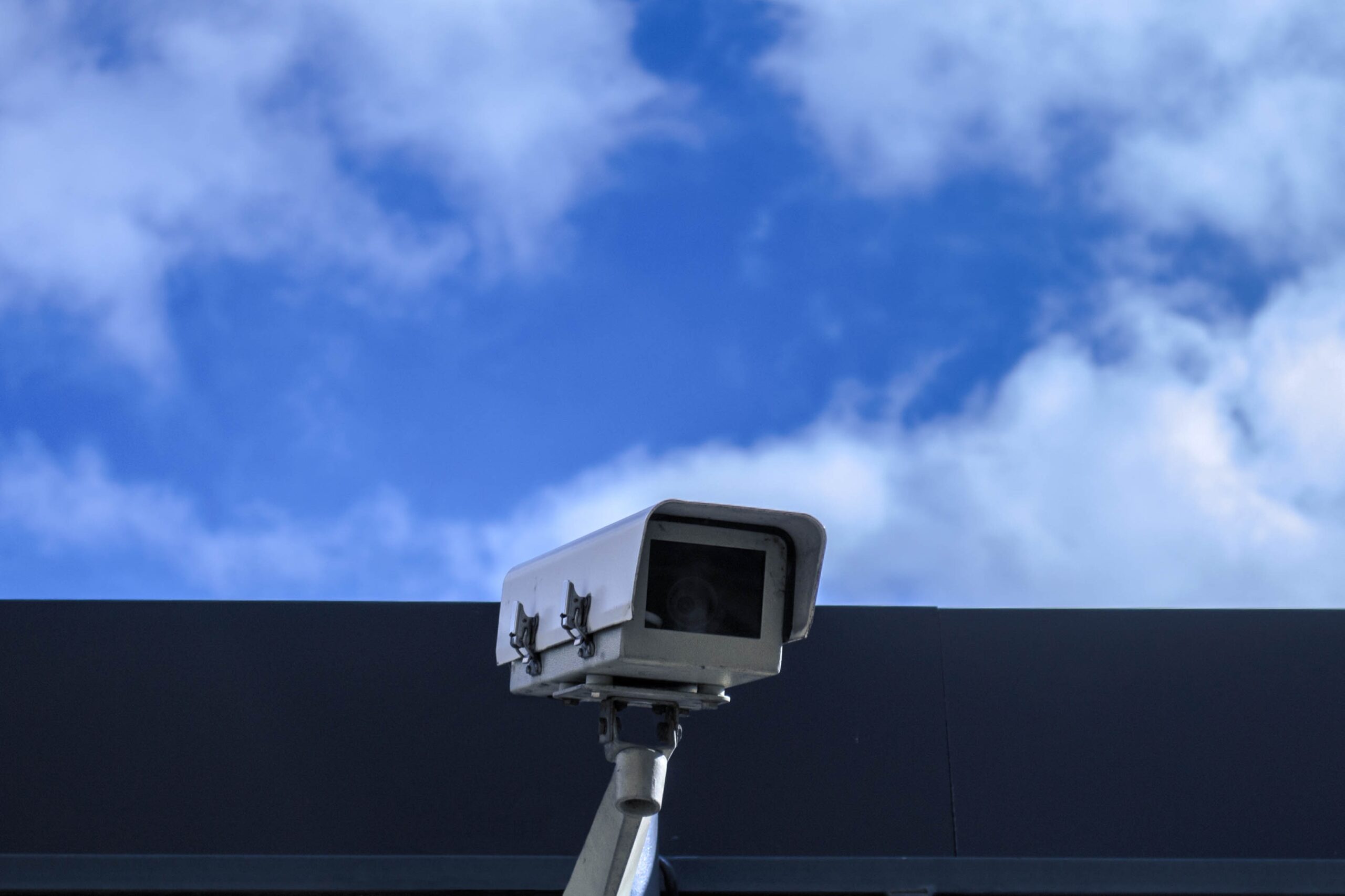
On the other hand, a bullet camera is better for long-distance coverage due to its big lens, while dome cameras are intended for short range surveillance. Most bullet cameras are also waterproof, so they are more appropriate for outdoor use.
How do infrared security cameras for business work?
The camera must detect something in order to produce an image, and even in areas of zero visibility there are distinguishable forms of energy that can be perceived. One such form of energy is infrared light radiation. An infrared camera can detect infrared light by using infrared LED lights, transferring the data it collects into an image visible on a screen.
Infrared light is lightly invisible to the naked eye. It has a much longer wavelength than normal light and a lower frequency, which is why it is undetectable without the appropriate technology. Such technology can take the form of infrared security cameras that use infrared LED (light-emitting diode) lights located peripheral to the camera lens.
Infrared cameras can capture images even in total darkness. As the light begins to fade, the camera automatically switches to infrared light mode, producing a black and white image on a monitor.
Is an infrared camera the same as a day/night camera?
Infrared security cameras are not day/night cameras and should not be confused as such. The latter type of camera does not use infrared light technology, requiring a minimal light source within the visible spectrum to produce a quality video feed.
The amount of light in a camera’s environment is referred to by the Latin term lux, and a worthwhile infrared camera can produce quality, albeit black and white image, in conditions of 0.0 lux. This is where it differs from a day/night camera, which can’t detect anything at all without light.
The quantity of infrared LED lights determines the detection range of an infrared camera in total darkness. Some of the more advanced technological hardware on the market can monitor objects and individuals as far as 150 feet into a complete dark void.
Infrared cameras are designed for indoor and outdoor use and might come with either short or long-range infrared LED lighting.
The best security cameras for business in Southern Ontario
Technology is constantly evolving. Suppose you’re a business owner focused on developing your venture rather than staying informed on security methods, products, and services advancements. In that case, we can help you get the necessary answers and equipment to protect your assets and personnel.
If you’re still having a hard time choosing the best camera for your business surveillance system, feel free to make the most of our knowledge and expertise. Call us at 416-613-8828 or write to us using the contact form on our website.
Our technicians have years of experience and are happy to help and get you started on the right track. Schedule a free site inspection today and receive a no-obligation quote on your upcoming security project.
SHARE